GuitarTuna
I joined Yousician Oy in May 2024 to work as a Senior Product Designer for the GuitarTuna app - a tuner app I personally use (for many years!) and love. While it's dream coming true for me to design for GuitarTuna, I deeply cared about our millions of users and their guitar playing habits and needs, and have been able to design experiences that not only make them more willing to stay (and pay for it), but also extend the app to more guitar hobbyists - yes, we are talking about both DAU and ARR, and that's our path to the company mission "make musicality as common as literacy".
The Playing Experience (Combined Play Mode Driving Engagement & Revenue)
The project started with a simple request: “combine two play modes.” But as I explored how players of different skill levels actually practice, it became clear the opportunity was bigger. Instead of just merging features, I reimagined the flow into a cohesive, adaptive playing experience that responds to each player’s level, interests, and preferences.

Platform: iOS, Android, tablets
My role: sole designer working with a team of a pm, devs, data, and content and tools teams
Timeframe: Jul 2024 – Jul 2025, multiple phases and experiments
The Problem
GuitarTuna has a song library of over 20k songs and 80% paid users subscribing to this “Play” subscription, contributing $14.5M ARR - but even those who’re paying don’t play that often. In the meantime, GuitarTuna Learn was launched a little after Play, introducing a new mechanism (adding songs and courses to a learning path) and another library of high quality step by step song learning content and even courses. Learn brought us quite a lot revenue quickly, but churn has been pretty high for Learn - users are excited, tried and subscribed, then they don’t come back for various reasons.

Understand Guitar Playing Habits & Needs
First thing first, grab your guitar and actually play like your users ;)

I love my Ibanez strat ♡
OK, back to business. The initial requirement was to clean up this mess - to combine this 2 modes, for the brand, also for high song DAU and retention. To translate this business requirement into user needs, I dug into existing research and conducted quick studies to map the guitar playing habits and needs across skill levels.

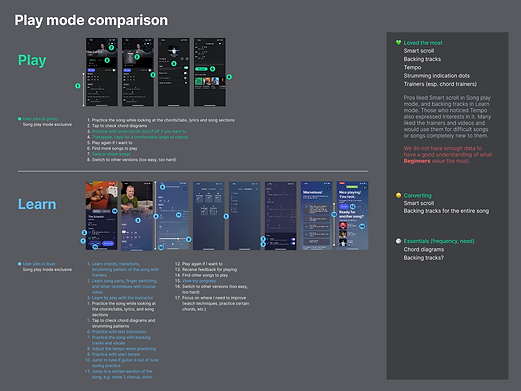
Journey map and existing mode comparison with research findings and data
Here are the findings from the research, combining with the data (Play users infrequent usage, Learn users high churn), some are product findings, others are usability, technical, or even content findings:
-
Skill level mismatch: advanced players down-level themselves, thinking Learn content or Play chords are too kindergarten for them, while beginners got stuck in chord trainers and lost motivation and patience
-
Unclear target segmentation: pros can play and use our content, but they are infrequent users, beginners is 70% of our traffic, but they just can’t play our content
-
Hard to build habit: users claim they’d use the app for infrequent need such as learn difficult songs, learn complete new songs, or just a pro version of a song
-
Other usability, technical or content findings: skip or stuck, chord detection issues, hard to find songs users like to play, beginners just can’t play the content we have
The Evolving Concept & Phased Experiments
While many of the problems and needs require commitment and planning with multiple teams - content to adjust the learn content, tools to improve detection and trainers, a dedicated team for personalization, I started the concept aligning with the team a few things we can focus on within scope:
-
“Personalized”, or a tailored song page based on skill level and previous usage
-
Streamline UX, combine Learn and Song play page to reduce confusion
-
Remove the strumming trainer temporarily until content and tools team upgrade it - almost all users hated it and got stuck there, despite skill level
In the meantime, I know the biggest problem about segmentation is still there, so I proposed (again and again), to many stakeholders, let’s take care of the beginners experience and let them have satisfying playing sessions. Although it was not taken care of in the scope of this project, I was able to get the team signed up for a few things to try:
-
Guide beginners during onboarding to the other product we have, built for beginners, so we don’t need to compete with our sister product
-
Provide guided tuning experience during onboarding, so at least they stay and learn how to tune
-
Provide tab playing experience, so beginners can play one note, one string at a time and enjoy their playing with backing tracks even
Here are the concepts evolved in various phases and experiments rolled out.


The Refined Requirement & New Direction
About a few months into this big playing experience upgrade project, there was a new requirement about adding strumming pattern instructions to the song playing experience, coming from a couple of studies. Users requested strumming patterns, or ranked it important in a survey, some mentioning it in a diary study too. I understand strumming patterns are important, but I had my doubts how people would like to learn it. So I planned and conducted an in-depth interview type of study with our research team, and we found something really interesting:
-
While users say they want strumming pattern instructions, almost all participants we talked to hated the strumming pattern instructions on Ultimate Guitars (our competitor who has strumming pattern info), they tried, and then never use it, because of the quality, also the way they learn strumming patterns
-
Not so surprising but, all participants, despite their skill level, learn the strumming patterns by listening to the original audio, figuring out the guitar strumming in that audio (so backing tracks without guitar track wouldn’t help in this case)
This is a wake-up call and also turning point of the project. Yes we can spend a quarter to build a perfect concept, or just spend a month to give the users what they needed the most - playing with the original audio, or YouTube audio, which all our competitors have. We, and also our competitors spend so much to produce the backing tracks and they have their value, but for most users, playing to the originals is good enough, and even enjoyable - they don’t need to switch back and forth between multiple apps.
I listened to the voice of the users and my own experience as a guitar player, and started the tough conversation early on by inviting the product team to some of the interviews. We were able to agree on the priority shift: play with YouTube first, and then a lightweight strumming pattern experiment with content we already have.

Play with YouTube design

Strumming patterns added to the vision
The Results
After so many experiments over a period of time, while song activation is flat since we didn’t touch the song discovery phase of the playing journey, both song DAU and surprisingly, conversion to free trial grew (song DAU +7% and conversion +10%). Retention is still being analyzed, as it’s also more of a habit or behavioral change we are working on (encouraging users, especially paying users, to play more often), I also believe more design exploration is needed.
Riff Of The Day (DAU-Driven Innovation)
This project came from one of the beginner-focused initiatives that I influenced the team during the playing experience exploration and research phase. What if even a beginner can play and enjoy a bite-sized beautiful iconic riff each day they open GuitarTuna? What if they can play and collect these super simple but iconic riffs, would it motivate them to come back more often?

Platform: iOS, Android, tablets
My role: sole designer working with a team of a pm, devs, data, and content and tools teams
Timeframe: Oct 2024 – Mar 2025, conception + release
The Opportunity
Playing guitar daily is not something an average guitar player or learner would commit to, for various reasons - we are busy, we have lives outside of our little practice room. But as the company moving to the Duolingo era (DAU-focused era), trying out something daily has definitely become a goal. Riff of the day was first launched on our sister product Yousician and was very successful, although it was more of a laid-back feature - you can play riff of the “day”, or just any riff in the past, you are free to browse the riff library, and there’s no pressure to finish a riff. Can we try something more gamey or emphasize “of the day” a bit more in GuitarTuna?

Yousician ROTD experience
Rapid Prototyping (Design & Implementation)
Although I would love to validate the need with GuitarTuna audience first, as the audience is very different from Yousician, for this project, we were pressured to get some prototype out fast. So my strategy was prototyping something and testing in house while prototyping. In order to do that, I planned the in house studies early on with research team, so they can recruit and schedule a few participants every week during the prototyping era.

Our test setup
With the Yousician riff of the day being super laid-back, we tried something extremely gamey for GuitarTuna based on the belief that we go all-crazy first, and then loosen up gradually to find the sweet spot. The initial product design was:
-
Every day there’s a new riff, personalized to user’s skill level, adjusted to previous user feedback
-
Users have to tune all strings in order to unlock today’s riff, before that they won’t know what song it is
-
Users have to play every note correctly in order to “collect” this riff to play after that day, otherwise it’s gone tomorrow, or they can pay to have access to all past riffs
-
The core playing experience is a step-by-step riff learning process, you listen, and play zero speed, then speed up (and play with backing tracks), and finally perform and being evaluated and receive a score after performing


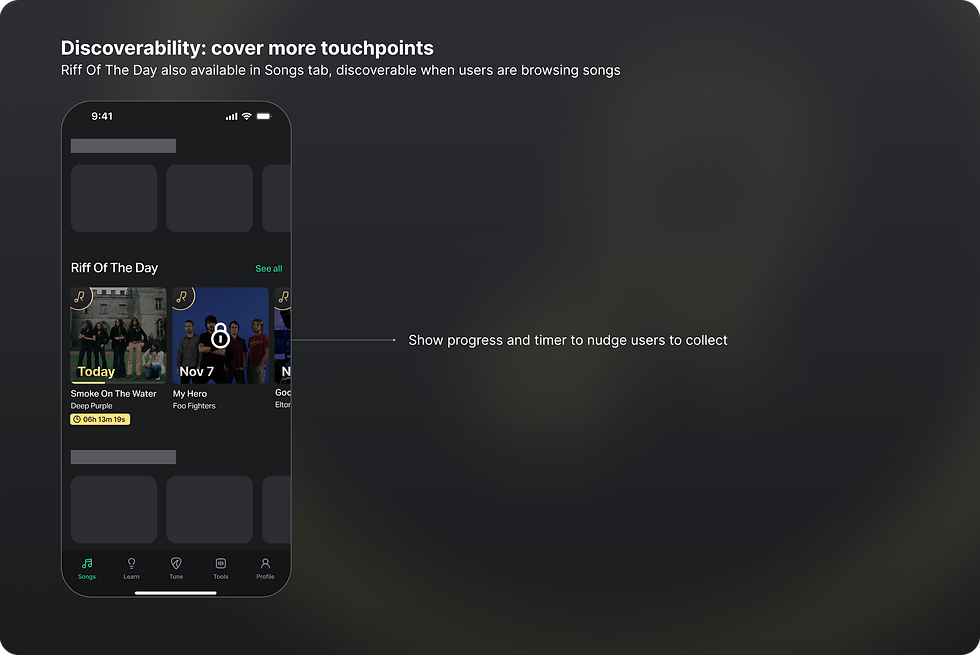
The weekly in-house user tests helped us understand many things while prototyping. For example, the core playing experience needed a few manual interactions in the beginning, but users hated having to touch the screen in the middle of playing a short riff, so we made it hands-free (and it was highly loved by later participants!). Also we got the general user perception of the feature: yes it’s kind of addictive and they do want to collect because of the feature design, but most also mentioned if it’s not a riff they really like, they’d probably lose patience. This validated my assumption about Yousician’s riff of the day - comparing to other exercises and songs on Yousician, ROTD is chill and quick, and you can always browse past riffs to find one you really like to play. But once the freedom of choosing what you like is gone, and the personalization is not there yet, making it too gamey might be very sustainable.
Customer Love & ROTD in songs tab
The first version was very well crafted in a very short time, and did have many uplifts - DAU was flat and retention was +2% for new users, song views was +28%, also gross bookings are +5%. However in a later iteration we started to see ARPU dropping and DAU still flat, we had to stop the experiment and that’s when we saw how much it was loved by customers. There were users posting in both Reddit and our Facebook group asking why is ROTD gone and they want it back.
Maybe we went too gamey for the first few experiments, but with the validation of customer love, we are moving the new experiment - making ROTD a home in Songs tab, and users can just open it to keep it forever, no more play every note correctly to collect.

